

If you’re financing a home this year, the OPR — Bank Negara’s Overnight Policy Rate — quietly sets the tone for your monthly installment. You don’t need to be an economist, but understanding how it works helps you borrow smart. Here’s what Cheras buyers should know in 2026.
👉 See indicative installments by unit on the D’Parc price list.
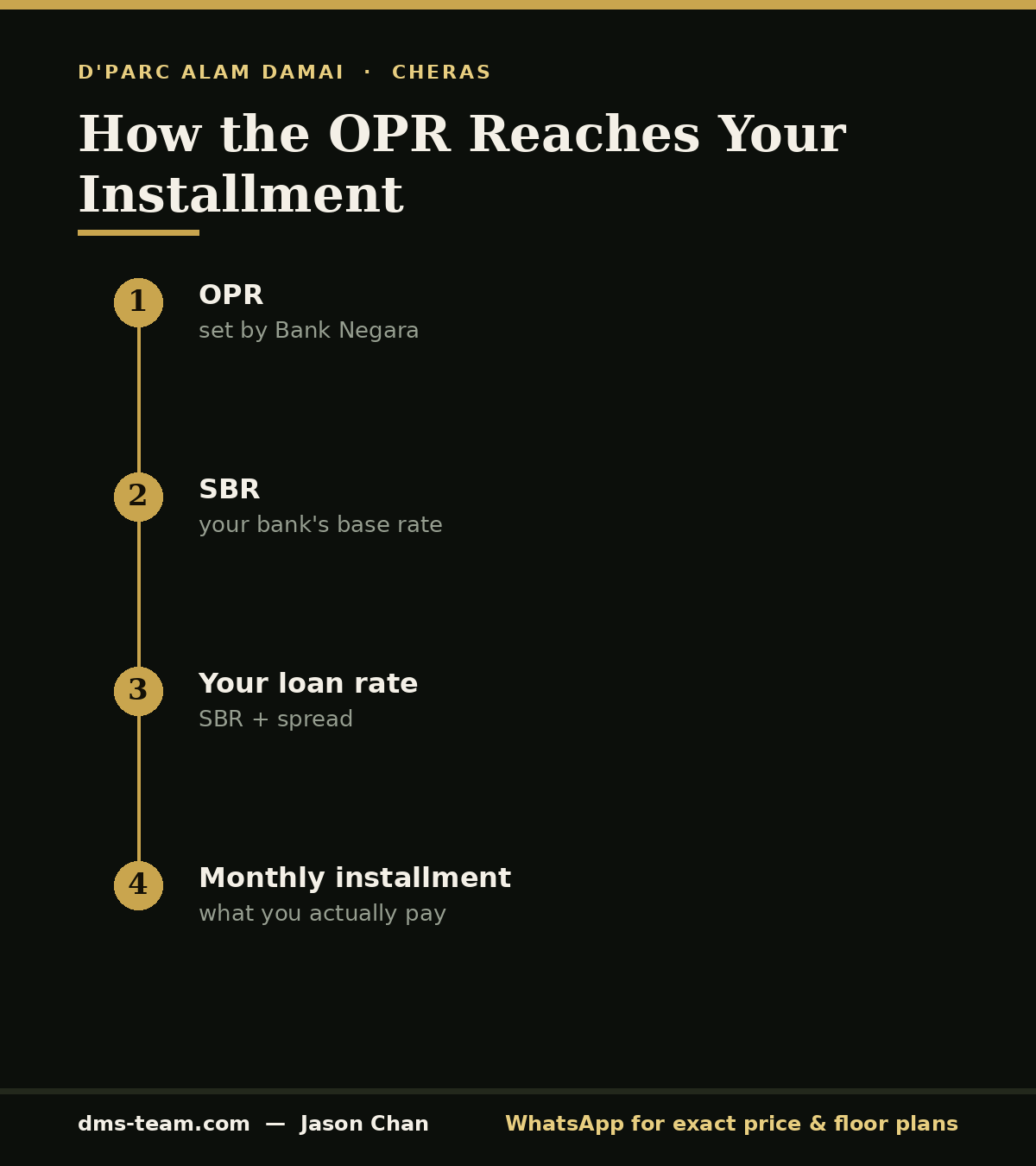
- The OPR (Bank Negara's rate) sets the tone for your installment through a simple chain: OPR to SBR to loan rate to monthly payment.
- Understanding fixed vs floating helps you borrow smart, but timing rates perfectly is not the winning move.
- An affordable entry (a sub-RM500k Cheras unit) beats rate-timing - it keeps installments manageable whatever rates do.
How the OPR Reaches Your Monthly Payment
It’s a simple chain: OPR → SBR → your loan rate → your installment. Bank Negara sets the OPR; your bank’s Standardised Base Rate (SBR) moves with it; your actual loan rate is SBR plus a spread; and that determines what you pay each month. When the OPR rises or falls, floating-rate installments follow.
New to the mechanics? Our Standardised Base Rate (SBR) guide explains it clearly.
Key takeaway: on an affordable loan, even a rate move translates into a relatively small ringgit change — one more reason the sub-RM500k band is comfortable to finance.
Fixed vs Floating: What It Means for You
- Floating rate (most home loans): your installment moves with the SBR/OPR — you benefit when rates fall, pay more when they rise.
- Fixed elements / flexi loans: offer predictability or the ability to park cash and reduce interest.
Want to see how your installment looks at today’s rate? WhatsApp Jason Chan for a current repayment estimate →
What Smart Buyers Do About Rates
- Buy within comfort, not at the ceiling — leave headroom for rate movements.
- Compare 2–3 banks — spreads above SBR differ, and small differences add up.
- Consider a flexi loan if you can park savings to offset interest.
- Don’t try to time the market — an affordable entry price protects you more than guessing rates.
Why an Affordable Entry Beats Rate-Timing
Buyers often wait for “the perfect rate” and miss the home. A smaller loan on a well-priced unit keeps your installment manageable across the rate cycle — the practical case we make in renting vs buying in Cheras. Certainty of a good entry price usually beats uncertainty over rates.
Bottom Line
The OPR shapes your installment through the SBR, but on an affordable Cheras home the impact of rate moves is manageable. Borrow within your comfort zone, shop your loan, and let a strong entry price do the heavy lifting.
Get Your Repayment at Today’s Rate
Skip the guesswork — see your real monthly figure now.
Then WhatsApp Jason Chan for a current repayment estimate, the SPA price list and a free loan-eligibility check: Message on WhatsApp →
Frequently Asked Questions
What is the OPR and why does it matter?
The Overnight Policy Rate is set by Bank Negara and influences your bank’s base rate (SBR), which drives your floating home-loan installment.
Will my installment change if the OPR moves?
On a floating-rate loan, yes — it rises or falls with the SBR. Ask your banker for the current rate.
Should I wait for lower rates to buy?
Timing rates is difficult; an affordable entry price usually protects you more than waiting for a rate move.
What’s the difference between OPR and SBR?
OPR is Bank Negara’s policy rate; SBR is your bank’s base rate that tracks it. Your loan rate is SBR plus a spread.
How can I reduce my interest?
Compare banks for a lower spread, consider a flexi loan to offset with savings, and keep your loan within comfortable limits.
Last updated 11 July 2026 · DMS Jason Chan, REN 78007