
Every investor eyeing this project eventually asks the same thing: what’s the right The Shang investment strategy — hold it for rent, or ride the MRT3 story and flip? Both are valid, but they suit different capital, timelines and temperaments. Here’s the clean split. (For area yield numbers, pair this with our Kuchai Lama rental yield guide.)
See full details on the main page → the investment fundamentals are on the official project page.
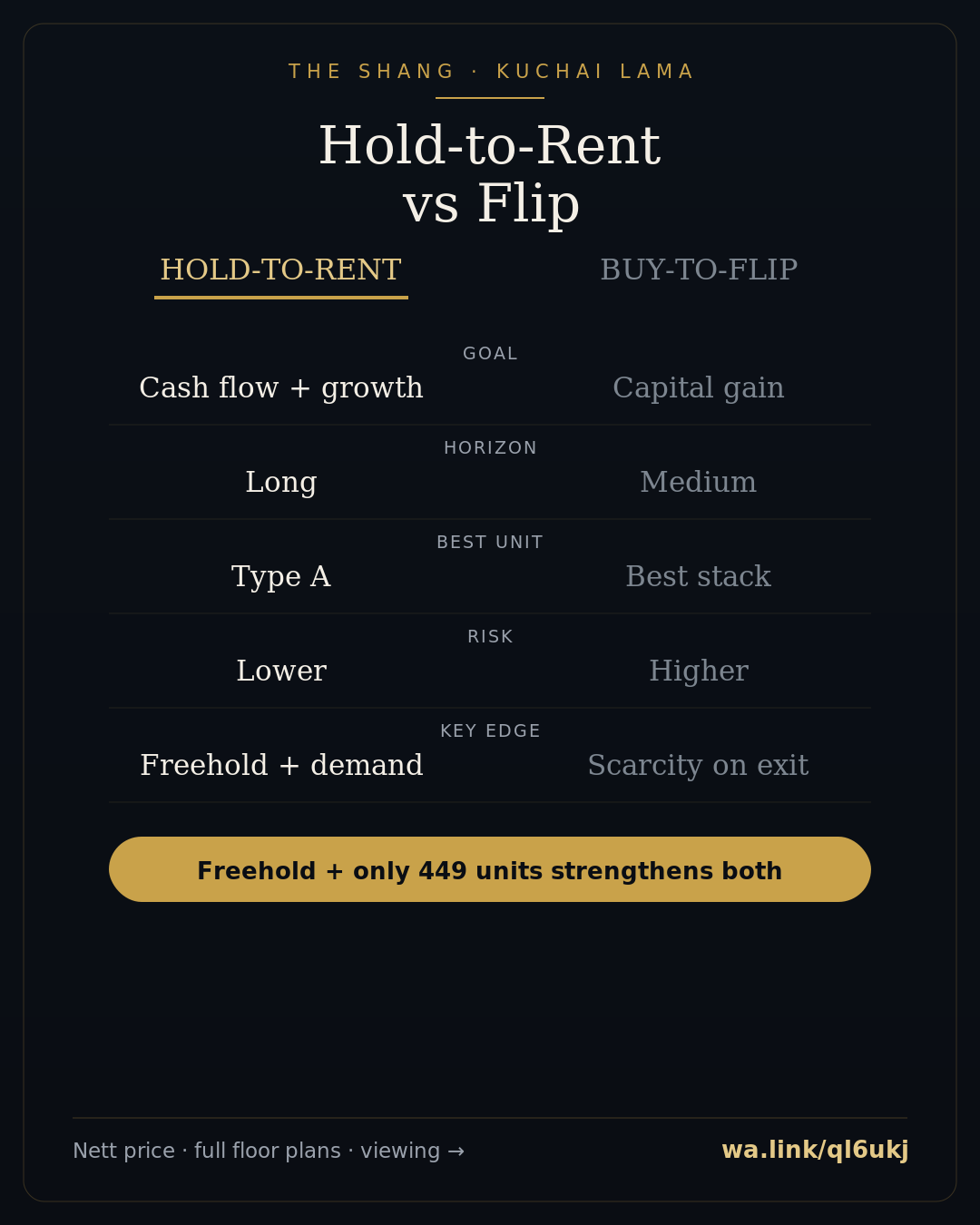
- Two valid strategies at The Shang: hold-to-rent (yield plus long-term growth) or buy-to-flip (ride the MRT3 appreciation).
- Hold-to-rent suits patient investors wanting cash flow; flipping suits those betting on the pre-MRT3 re-rating.
- Your capital, timeline and temperament decide which fits - the fundamentals support both.
Strategy 1 — Hold-to-rent (the yield play)
Best for: patient investors who want cash flow + long-term capital growth.
- The unit to buy: typically Type A (893 sq ft) — lowest entry, widest tenant pool, easiest to let.
- The demand drivers: school catchment (Choong Wen), the food scene, the coming MRT3, and a mature area tenants already know.
- The Shang edge: freehold (no lease drag on future value) and low density (fewer identical units competing for the same tenant).
- The mindset: collect rent, let the MRT3 re-rate the asset underneath you, and hold through the cycle.
Strategy 2 — Buy-to-flip (the appreciation play)
Best for: investors positioned to sell into the MRT3 re-rating rather than hold forever.
- The thesis: buy in the early construction window, exit as the line and interchange price in.
- The unit to buy: an in-demand stack/facing on a good floor — the units the next buyer will want most.
- The Shang edge: only 449 homes means tight resale supply on exit — you’re not one of a thousand identical listings.
- The caution: flipping depends on market conditions and timing; it carries more risk than holding, and no return is guaranteed.
Which is right for you?
| Hold-to-rent | Buy-to-flip | |
|---|---|---|
| Goal | Cash flow + growth | Capital gain |
| Horizon | Long | Medium |
| Best unit | Type A (yield) | Best stack/facing |
| Risk | Lower | Higher |
| Key edge | Freehold + demand | Scarcity on exit |
The honest answer: for most buyers, hold-to-rent is the lower-risk, higher-probability play, with the MRT3 upside as a bonus you capture without having to time an exit. Flipping can pay more but demands more skill and luck.
Quick takeaways
- Hold-to-rent = yield + growth, lower risk, usually Type A.
- Buy-to-flip = MRT3 capital gain, higher risk, best stack/facing.
- Freehold + only 449 units strengthens both — no lease drag, tight resale supply.
Get the confirmed floor plans and the current price.
👉 View The Shang Kuchai Lama · 💬 WhatsApp Jason for the current nett price, full floor plans & a no-obligation viewing.
Frequently Asked Questions
Is The Shang better for rent or flip?
Hold-to-rent is the lower-risk play with MRT3 upside as a bonus; flipping can pay more but carries more risk.
Which unit is best for rental?
Type A — lowest entry and the widest tenant pool.
Why does freehold help investors?
No lease drag on future value, unlike leasehold competitors.
How does low density help resale?
Only 449 homes means fewer identical listings competing when you sell.
Can you model my numbers?
Yes — message Jason for a yield or flip projection.
Last updated 26 August 2026 · DMS Jason Chan, REN 78007